
You're looking at a product cost and emissions model for a Screw Compressor manufactured in China. A screw compressor is a rotary compressor that compresses air using intermeshing helical rotors. It delivers continuous, efficient airflow for industrial and commercial operations.
Each model includes upstream materials, components, and manufacturing processes all the way to the factory gate.
Product Material Breakdown
Top Cost Contributors
Materials: rotor assembly (alloy steel) (38%)
Materials: rotor assembly (alloy steel) (38%)
Value Add (16%)
Value Add (16%)
Materials: electric motor (15%)
Materials: electric motor (15%)
Labor: Indirect Labor (8%)
Labor: Indirect Labor (8%)
Your biggest cost drivers represent the highest potential for savings
Alternative Sourcing Scenarios
Current sourcing location

China
Alternative Sourcing | Estimated Cost Impact | Estimated CO2e Emissions Impact |
|---|---|---|
 United States | +25.0% | -22.5% |
 Mexico | +2.7% | -17.0% |
Alternative Designs & Materials Recommendations
Score: 8.9/10
Work with your supplier to transition to renewable energy.
Emission Intensity Impact
-44.3%
Cost Impact
-1.3%
Implementation Difficulty
Score: 5.5/10
Work with your supplier to source low-alloy steel housing from China.
Emission Intensity Impact
0.0%
Cost Impact
Analyze your own product
Go beyond general models. Upload or import any Bill of Materials to instantly see detailed cost, carbon, and risk insights.
Analyze your own product
Go beyond general models. Upload or import any Bill of Materials to instantly see detailed cost, carbon, and risk insights.
Smart sourcing
Compare sourcing locations, suppliers, and transportation side by side. Instantly see how costs, emissions, and risks shift when you change where a product is made.
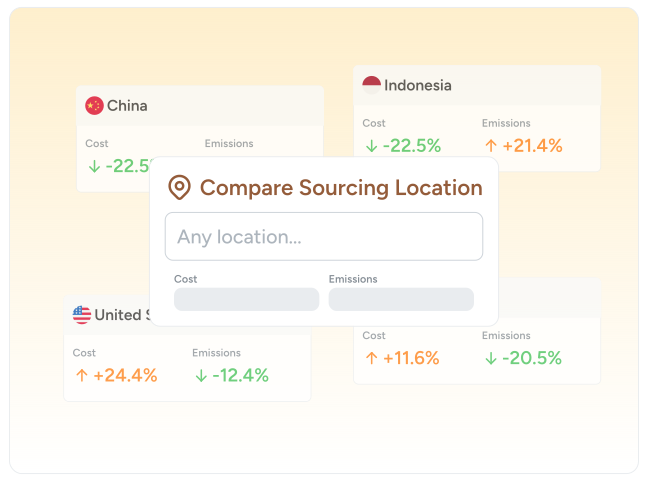
Smart sourcing
Compare sourcing locations, suppliers, and transportation side by side. Instantly see how costs, emissions, and risks shift when you change where a product is made.
Optimize Designs & Materials
Explore alternative materials, components, and configurations to balance cost, carbon, and risk. Make informed trade-offs early in the design cycle to launch better products, faster.
Detailed should-cost models with cost drivers
Full product intelligence for any sourcing country
Analyze impact of design changes
Supplier discovery tools with contact data and profiles
Visibility into drivers gives you leverage in design, sourcing, and supplier discussions
Top Emission Contributors
1,288.4
kgCO2e
Manufacturing (47%)
Manufacturing (47%)
Materials: wrought aluminum (16%)
Materials: wrought aluminum (16%)
Materials: electric motor (13%)
Materials: electric motor (13%)
Materials: low-alloyed steel housing (11%)
Materials: low-alloyed steel housing (11%)
Your biggest emission drivers represent the highest potential for savings
Even small design or sourcing changes can create outsized impact and drive meaningful reductions.
Manufacturer Should Cost
$
.83
USD
Note: This analysis covers Materials, Components, and Manufacturing only; it does not include downstream costs (e.g., outbound shipping, warehousing, distribution/retail fees).
Tariff Impact
+25%
of Landed Cost
HTS Code
84148016
Sourced from
China
Tariffs can materially change landed cost and competitiveness
Current sourcing location
China
Alternative Sourcing | Estimated Cost Impact | Estimated CO2e Emissions Impact |
|---|---|---|
United States | +25.0% | -22.5% |
Mexico | +2.7% | -17.0% |
0.0%
Implementation Difficulty
Optimize Designs & Materials
Explore alternative materials, components, and configurations to balance cost, carbon, and risk. Make informed trade-offs early in the design cycle to launch better products, faster.
Strengthen Supplier Strategy
Uncover true cost drivers to gain leverage in supplier negotiations. Collaborate with suppliers on improvements like renewable energy adoption, material shifts, or process changes to enhance resilience and sustainability.
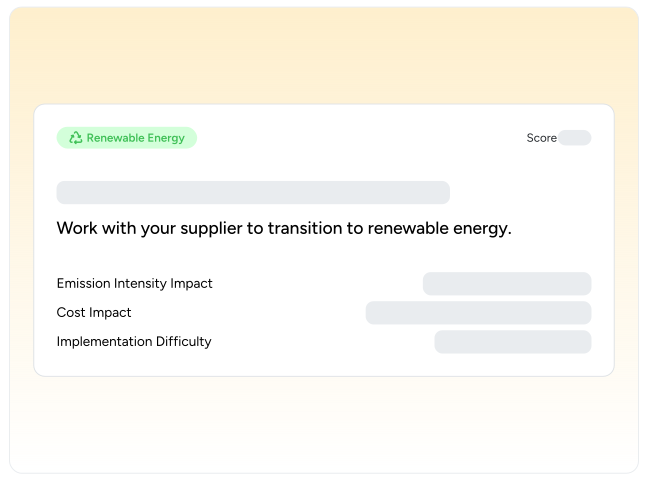
Strengthen Supplier Strategy
Uncover true cost drivers to gain leverage in supplier negotiations. Collaborate with suppliers on improvements like renewable energy adoption, material shifts, or process changes to enhance resilience and sustainability.